



















How Carnival Costumes Are Made
Carnival costumes are made through a detailed process that combines design, sewing, wirework, decoration, and practical testing. The process usually begins months before Carnival, when designers develop a theme and create sketches showing the costume’s colours, structure, feathers, headpieces and accessories. In large Carnival productions, different specialists may handle different stages, from sewing and wire bending to decoration and final fitting. After the design is approved, makers select materials such as stretch fabrics, wire, foam, beads, sequins, rhinestones, feathers and other decorative materials. Wire frames are built for larger pieces such as headpieces and backpacks, while fabric is cut and sewn to create the main costume. Feathers, beads and rhinestones are then carefully attached to complete the design.

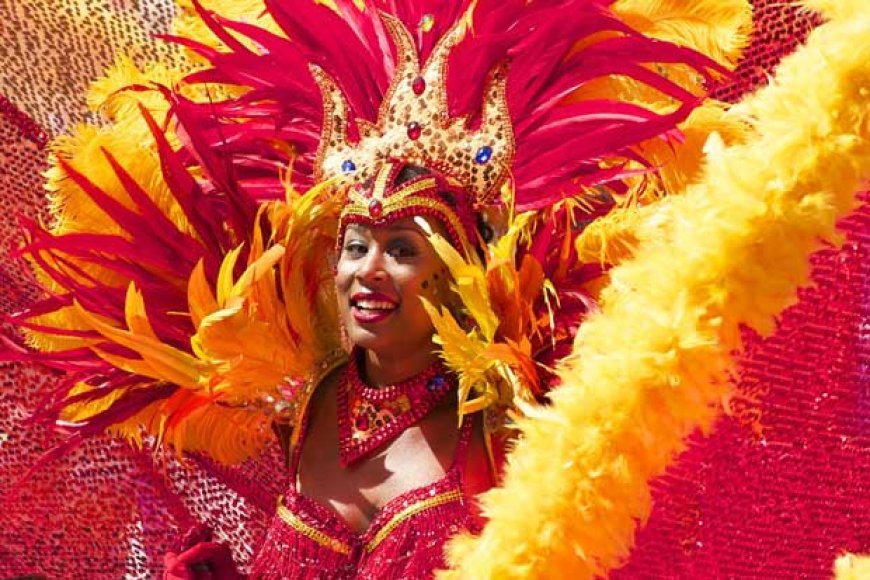
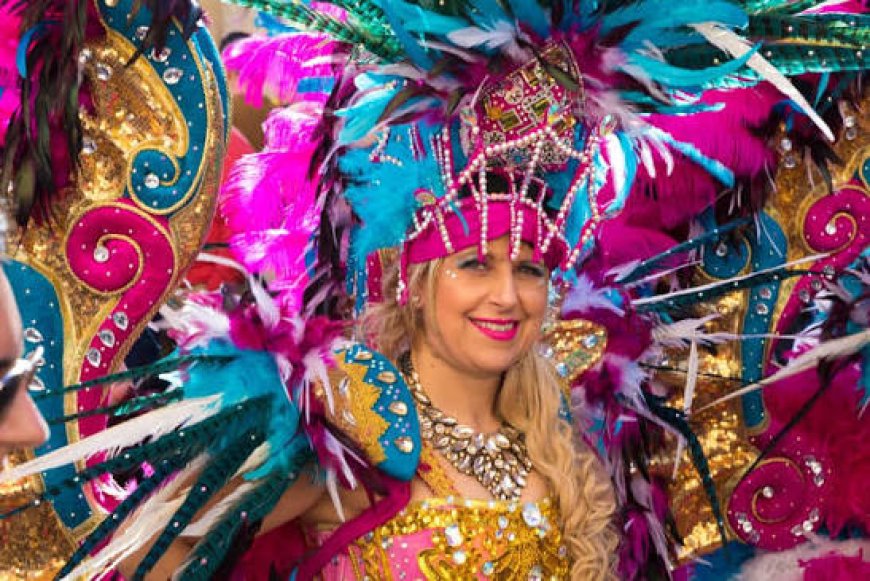
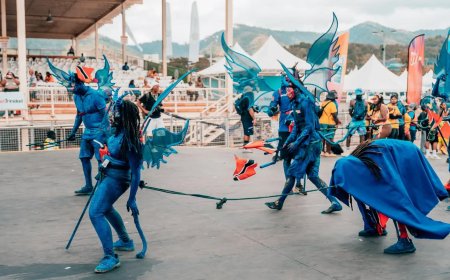
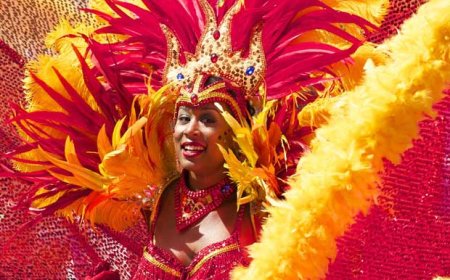
When people watch a Caribbean Carnival parade, the first thing they notice is movement. Costumes rise above the crowd, feathers shake with the music, rhinestones catch the sunlight, and large headpieces and backpacks move as masqueraders dance along the road. It can look as if the costumes were designed simply to be eye-catching, but there is a much more practical process behind them. A Carnival costume has to be designed, measured, constructed, decorated, tested and fitted before it is ready for the road.

In major Caribbean Carnival destinations, costume production can begin months before the actual celebration. Designers work with wire, foam, fabric, feathers, sequins, rhinestones, beads, mesh and other materials. Sewing machines operate alongside glue guns and hand tools, while specialist makers build the frames that support large costume pieces. In Trinidad and Tobago, mass camps function as production centers where designers, wire benders, seamstresses, decorators and other workers turn sketches into costumes for masqueraders. Recent reporting in 2026 describes Carnival costume production as a wider creative industry involving design, garment construction, sourcing, logistics and skilled craft work.
The exact method differs from one island, Carnival band or designer to another. A costume for Trinidad Carnival may have different construction requirements from one made for Barbados Crop Over, Toronto Caribbean Carnival or Notting Hill Carnival. Some costumes are relatively simple, while King and Queen Costumes can become large individual structures that require additional engineering and support. But the basic process is similar: an idea becomes a design, the design becomes a structure, and that structure is gradually covered with fabric, decoration and details until it becomes a costume that can survive hours of movement.
The Process Starts With a Theme
Before anyone starts bending wire or attaching feathers, the designer needs to know what the costume is supposed to represent. Carnival bands generally organize their costumes around themes. A theme may be connected to nature, history, mythology, Caribbean culture, music, colors, places or an abstract idea.
The designer develops sketches and decides what the costume should look like from different angles. This is important because Carnival costumes are not viewed from only one position. A masquerader is moving through a crowd, dancing and turning, while spectators and photographers may see the costume from the front, side or back.
The sketch therefore needs to communicate more than decoration. It must show the overall shape, the size of the headpiece or backpack, the placement of the feathers, the body garment, the colors and the important decorative elements.
At this stage, the designer also has to think about practicality. A costume that looks good on paper may not work when a person has to wear it for several hours. Weight, balance, flexibility and security become important design questions.
Modern Carnival costume design combines fashion decisions with basic structural engineering. Makers need to understand how a frame will behave when it is moving, where weight should be placed and how attachments can remain secure during dancing. Wire bending remains an important part of this work, particularly for large pieces.
Choosing the Materials
Once the design is approved, the next stage is material selection. Carnival costumes use a wide range of materials because different parts of the costume perform different jobs.
Stretch fabrics such as Lycra and spandex are commonly used for the base garment because they can fit closely to the body while allowing movement. Mesh can be used in areas where the designer needs structure or ventilation. Foam is useful for creating shapes and lightweight surfaces. Wire provides the skeleton for many headpieces, backpacks and other large pieces.
Then there are the decorative materials. These can include sequins, rhinestones, beads, crystals, trims, ribbons, feathers and decorative stones.
The choice is not simply about appearance. A material that is too heavy can make a costume uncomfortable. A material that does not respond well to heat or humidity can create problems during a Caribbean parade. Decorations also have to be attached firmly enough to withstand dancing, transportation and repeated handling.
A traditional Carnival workshop may therefore contain rolls of fabric, spools of wire, foam sheets, bags of beads, rhinestones, feathers, glue, thread and sewing equipment. The materials may look like a collection of separate craft supplies, but each one has a specific role in the finished costume. A Craft Council tutorial on mass costume construction, for example, identifies materials including foam, hot glue, rhinestones, sequins, ostrich feathers, stretch fabric and sewing equipment.
Building the Wire Frame
One of the most important hidden parts of a large Carnival costume is the frame. Before feathers or rhinestones are added, the maker may need to create a structure that gives the costume its shape. Wire is cut and bent using hand tools such as pliers and cutters. The maker follows the original design while creating curves, supports, loops and attachment points.
This is skilled work because the frame needs to be strong without becoming unnecessarily heavy. It also needs to be balanced. If a large backpack or headpiece is heavier on one side, the masquerader may have difficulty wearing it comfortably.
For large costumes, the frame may be reinforced with additional materials. Depending on the design, makers may use fiberglass, foam, plastic, netting or other structural components. Historical accounts of Trinidad Carnival costume construction describe wire being used alongside materials such as bamboo, fiberglass and papier-mâché.
The frame is effectively the skeleton of the costume. Once it is stable, the decorator can begin adding the visible materials.
Shaping Foam and Other Lightweight Materials
Foam is useful because it can create volume without adding as much weight as many solid materials. A maker can cut foam into specific shapes and attach it to the wire structure. For example, a curved section of foam can help create the surface of a wing, fan, crown or decorative panel. The foam can then be covered or decorated with fabric, sequins, rhinestones or feathers.
The goal is to create a strong visual form while keeping the costume manageable for the person who will wear it. This is particularly important for large pieces. A Carnival costume can become physically demanding when the wearer has to dance, walk and remain active for hours. The designer therefore has to think about the person inside the costume, not just the appearance of the costume itself.
Making the Base Garment
While the large decorative structures are being constructed, another part of the team may be working on the base garment. Depending on the Carnival and costume section, this might be a bikini-style set, shorts, a bodysuit, a decorated top or another fitted garment. Stretch fabric is often useful because it allows movement and can accommodate different body shapes.
Measurements are important. The garment needs to fit securely because the masquerader will be dancing and moving constantly. The base garment also establishes the foundation for the costume's decorative design. Rhinestone patterns, sequins, trims and other details can be attached after the basic garment has been sewn.
In larger production operations, sewing can become a specialized stage of the process. Different people may handle cutting, sewing, decorating and final assembly rather than one person completing every part of the costume.
Adding Feathers
Feathers are one of the most recognizable materials in Carnival costumes, but putting them onto a costume is more than simply gluing them in place.
The maker has to consider direction, density, colour and layering. Feathers can be arranged to create fans, wings, crowns, collars, backpacks and other shapes.
A common approach is to build layers so that the lower feathers support the appearance of the upper ones. The maker also has to create attachment points that are strong enough to keep the feathers in position.
Natural feathers have their own characteristics. They can vary in size, shape and texture, so the decorator needs to sort them and decide where each piece works best. Some designers also experiment with alternative materials. Carnival costume makers have used materials other than natural feathers to create similar visual effects, including cut synthetic or recycled materials.
This reflects a wider trend in costume construction: designers are not restricted to one traditional material. They can experiment with different textures and construction methods while still keeping the basic Carnival silhouette.
Beads, Sequins and Rhinestones
Once the structure and fabric are ready, the costume begins to develop its detailed finish. Rhinestones and sequins are often attached individually or in patterns. Beads may be sewn onto fabric or used in hanging sections. Decorative trims can be applied around edges to cover joins and create a finished appearance.
This stage can take considerable time because small decorations have to be placed carefully. A designer may create repeated patterns across a costume so that different pieces look like part of the same collection.
Rhinestones also have a practical visual purpose. They reflect light as the masquerader moves. This means a costume can appear different when seen under sunlight, stage lighting or photography.
The decoration stage is therefore not just about adding more material. It is about controlling where the eye goes. A designer can use larger stones in important areas, smaller stones around them and different textures to create contrast.
Constructing the Headpiece
The headpiece can be one of the most complicated parts of a Carnival costume. It needs to be visually strong but also secure enough to stay on the masquerade’s head while walking and dancing. The construction may begin with a lightweight base or wire structure. Feathers, rhinestones, beads and fabric are then attached according to the design. The maker has to think carefully about balance because a headpiece that is too heavy or uneven can become uncomfortable.
Some designs are relatively small, while others can extend significantly above or around the wearer's head. The larger the structure becomes, the more attention must be given to support and stability. This is why costume construction involves both craft and practical engineering. The finished piece has to remain connected to the wearer while moving through a crowded parade environment.
Building the Backpack or Back Piece
The backpack or back piece is another major component of many Caribbean Carnival costumes. It can include wings, feathers, fabric panels, wire shapes or other decorative structures. A harness or straps are used to connect the structure to the wearer. The maker needs to distribute the weight so the piece does not constantly pull backward or sideways. The attachment points must also be strong because the back piece moves whenever the wearer dances.
For this reason, the structure is often built first and decorated later. The basic frame is tested before the final decoration is added. A Craft Council mas costume guide notes that feathered back pieces can be built around welded wire frames specifically because the structure needs to be strong enough to withstand a full day of dancing.
Testing Weight, Movement and Durability
Before Carnival, costume makers have to think about what happens outside the workshop. The costume may be transported in vehicles, stored before the event, handled by volunteers and repeatedly put on and removed. Decorations can come loose, feathers can bend and wire can become distorted if the costume is not handled properly. Large costumes may also need special transportation arrangements.
For King and Queen Costumes, the engineering challenge can be even greater. These costumes can become very large individual structures and may be supported by wheels or other systems so that the performer can move them. The testing process therefore looks at more than appearance. Makers need to know whether the costume can actually function on the road.
The Role of the Mas Camp
A mass camp is often where the different stages of costume production come together. The camp may operate for months before Carnival. Designers work alongside decorators, wire workers, sewing specialists and other craftspeople. Materials are stored there, costumes are assembled there and masqueraders may come there for fittings and collection.
Modern mass camps can resemble a combination of workshop, fashion studio, production center and customer-service operation. They may manage thousands of costume components and large numbers of masqueraders. The scale varies significantly. Some costume makers work in small studios or home workshops, while major bands can require larger production operations.
Recent reporting from Trinidad and Tobago emphasizes that Carnival costume production involves a network of skilled workers and suppliers rather than a single designer working alone.
King and Queen Costumes Are Different
Regular band costumes are generally produced in sections so many masqueraders can participate with related designs. King and Queen Costumes are different. They are usually individual creations designed for a specific performer and competition. Because they can be much larger, the construction process can involve more structural work. Wire frames, large decorative surfaces, wheels, supports and harnesses may all become part of the design.
The costume has to communicate its theme from a distance while allowing the performer to control it. The designer therefore has to balance size with movement. A giant structure that cannot be moved effectively is not successful; regardless of how good it looks when standing still. At competitions such as the Toronto Caribbean Carnival's King and Queen Showcase, these costumes are treated as individual portrayals rather than the matching sections worn by regular masqueraders.
How Technology Is Changing Costume Making
Carnival costume making remains strongly dependent on hand skills, but technology is becoming part of the process. Designers can use digital drawing programs to develop concepts, measure proportions and prepare visual references. Some workshops use modern cutting methods or alternative materials to produce shapes that would be difficult to make entirely by hand.
Laser-cut materials, for example, have been used to create decorative shapes and alternative feather-like textures. However, technology does not remove the need for skilled craftsmanship. Someone still has to understand how the costume fits a person, how a wire structure behaves and how the finished piece will move. The most effective process often combines traditional handwork with modern production techniques.
Why Carnival Costumes Take So Much Work
The biggest misunderstanding about Carnival costumes is that people often see only the finished product. A masquerader may wear a costume for a day or two, but the production behind it can take months. The work includes designing, sourcing materials, cutting, bending wire, sewing, gluing, decorating, fitting, repairing, packaging and organizing the finished costumes.
One costume can contain hundreds or thousands of individual decorative elements. A large section of costumes can require an even bigger production effort. That means Carnival costume making is not simply a hobby or decoration project. It is skilled creative labour. It also supports a network of people. Designers, seamstresses, wire benders, decorators, material suppliers, photographers, transport workers and other specialists can all become part of the Carnival production system.
From Workshop to Carnival Road
Eventually, the costume leaves the workshop. It may be carefully packed and transported to the Carnival venue. Masqueraders collect their costumes or arrive for final preparation. Headpieces and backpacks are attached, body garments are fitted and final adjustments are made. Then the work of the makers becomes part of the public celebration. The costume has to do what it was designed to do: move.
Feathers respond to the wind. Sequins reflect sunlight. Wire structures maintain their shape. Fabric stretches with the dancer. Headpieces remain secure. Backpacks stay attached. For the costume maker, this is the final test. A costume that survives the road while allowing its wearer to dance comfortably has successfully completed a long production process.
The Craft behind the Celebration
Carnival costumes may look like they are made mainly from feathers, beads and rhinestones, but those materials are only the visible part of the process. Underneath them are wire frames, fabric construction, careful measurements, structural supports and many hours of manual work. The process starts with an idea and gradually becomes physical. Designers develop themes. Makers select materials. Wire benders create structures. Seamstresses build garments. Decorators add feathers, beads and rhinestones. Teams conduct fittings and make adjustments. Finally, the completed costume reaches the road.
The craft continues to change as designers experiment with materials and production methods, but the basic challenge remains the same: create a costume that looks strong, fits a person and can withstand hours of movement. That is what makes Carnival costumes such an important part of the celebration. The parade may last only a short time, but the work behind each costume begins months earlier. What the public sees on Carnival day is the final stage of a much longer process involving design, craft, engineering and teamwork.
What's Your Reaction?
 Like
0
Like
0
 Dislike
0
Dislike
0
 Love
0
Love
0
 Funny
0
Funny
0
 Angry
0
Angry
0
 Sad
0
Sad
0
 Wow
0
Wow
0